
AEO vs SEO: What's the Difference in 2026? (Simple Guide)
I didn’t set out to learn about AEO. I was just trying to get my blog to rank.
So I did what everyone does – searched “how to rank my blog,” “how to use SEO,” the usual. And somewhere in that rabbit hole, a term kept popping up that I’d never seen before: AEO. Turns out it’s growing even faster than SEO, and it can help a blog rank in places SEO can’t reach.
Here’s what I assumed at first: AEO, SEO, GEO – same thing, right? Just different engines. SEO works on Google and Bing, AEO works on AI, and the process is basically the same. That’s what I thought.
It’s not. And once I understood how they actually differ, it clicked why knowing the difference matters – because if you don’t, you end up optimizing for the wrong thing and spinning in circles.
So this is the guide I wish I’d found on day one. I’ll break down what AEO, SEO, and GEO actually are, how they’re different, whether you need them all, and the tools that help – in plain English, from someone who just went through the confusion myself.
The short version: AEO (Answer Engine Optimization) gets your content picked as the single answer by AI tools like ChatGPT and Google’s AI Overviews. SEO (Search Engine Optimization) gets you ranked in the traditional blue links. GEO (Generative Engine Optimization) gets you cited among the sources AI pulls together in a conversation. Now let’s break each one down properly.
What Is SEO? (The Foundation)
SEO is the practice of optimizing your content so it ranks in traditional search engine results – the list of blue links you see on Google or Bing. It’s been the backbone of online visibility for over two decades.
The core idea is simple: when someone searches for something, you want your page showing up as high as possible in the results. You do that through a few key things:
- Keywords – targeting the words people actually type into search
- Backlinks – other websites linking to you, which signals trust to Google
- On-page optimization – titles, headers, and structure search engines can understand
- Content quality – genuinely useful pages that answer what people came for
The way you measure SEO success is straightforward: rankings and clicks. The higher you rank, the more people click through to your site. Simple as that.
What Is AEO (Answer Engine Optimization)?
AEO is the practice of optimizing your content so that AI answer engines – like ChatGPT, Perplexity, and Google’s AI Overviews – quote or cite your content as the answer. Think of it as the newer sibling of SEO, born from the rise of AI search.
Here’s what changed. Instead of typing a query and scrolling through ten links, more and more people now just ask an AI and get a single, direct answer back. When that happens, there’s no list of links to rank in anymore – there’s one answer. AEO is about being the source behind that answer.
Content built for AEO usually looks like this:
- Direct answers – the response comes in the first sentence or two, not buried three paragraphs down
- Clear structure – headings, short paragraphs, tables, and FAQs the AI can easily read
- Question-and-answer format – because that’s how people actually talk to AI
And the way you measure AEO success is different from SEO. It’s not always about clicks – it’s about whether the AI picks you as the answer when someone asks a question in your space.
AEO vs SEO: The Key Differences
Both aim to get you found – but they play out very differently. Here’s a side-by-side look:
| Aspect | SEO | AEO |
|---|---|---|
| Goal | Rank in the list of links | Be the quoted answer |
| Where it shows | Google/Bing results pages | ChatGPT, Perplexity, AI Overviews |
| Content format | Keyword-optimized pages | Clear, direct answers |
| Success looks like | Clicks to your site | Being picked as the AI's answer |
| Content style | Comprehensive articles | Question → direct answer |
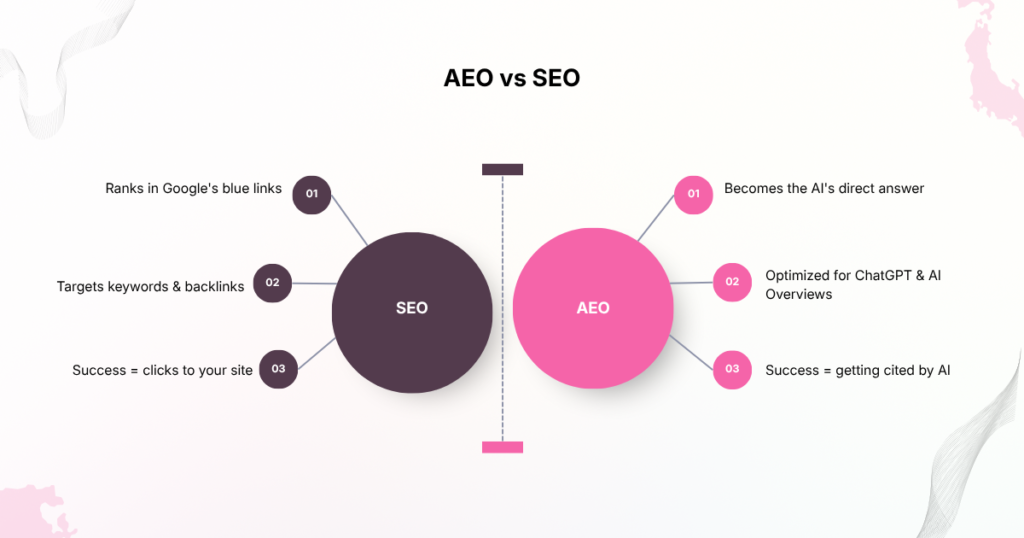
The simplest way to hold the difference in your head: SEO gets you into the list of options. AEO makes you the option. With SEO you’re competing to be one of ten links. With AEO you’re competing to be the single source the AI trusts enough to repeat.
What About GEO? (AEO vs SEO vs GEO)
You’ve probably also seen GEO thrown around alongside AEO. They’re related, but not the same – and here’s the difference that actually matters:
AEO (Answer Engine Optimization) is about becoming the single, direct answer – the one clean response that shows up in a featured snippet, a voice search result, or a quick AI reply. One question, one answer, and you want to be it.
GEO (Generative Engine Optimization) is about being one of the trusted sources that conversational AI pulls together – when a tool like ChatGPT or Perplexity builds an answer by synthesizing and citing multiple sources, GEO is about making sure yours is one of them.
So here’s the simplest way to hold all three:
- SEO -> rank in the list of blue links
- AEO -> be the single answer
- GEO -> be one of the cited sources the AI weaves into its answer
One Honest Note: These terms are still new, and even experts don’t fully agree on where the lines fall – some people still use AEO and GEO interchangeably. But this is the distinction most sources are settling on, and it’s worth understanding rather than lumping them together.
Do You Need All Three?
Yes – for now, you do. Traditional search still drives the majority of web traffic, so SEO isn’t going anywhere. But AI search is growing fast, and AEO and GEO are how you stay visible as that shift picks up speed.
Most people think AEO and GEO are just the “new SEO” – and that’s exactly what sends them down the wrong route. They’re not a replacement. SEO is the foundation that AEO and GEO are built on. Skip it, and the other two have nothing to stand on.
Here’s the honest way to think about it: AEO and GEO don’t replace SEO – they’re added on top. And the good news is a lot of what makes content rank well in SEO (clear structure, genuine helpfulness, good answers) also helps it get picked up by AI engines. So the three overlap more than they compete.
If you’re just starting out, build on a solid SEO foundation first – then layer in the AI-search habits (direct answers, FAQs, clean structure) so your content is ready for all three worlds.
If you’re just getting started with AI, exploring the right tools makes this much easier.
AEO vs SEO - Frequently Asked Questions
Is AEO replacing SEO?
No. AEO is not replacing SEO – the two work together. Traditional search still drives most traffic, while AEO helps you stay visible as AI search grows.
What is the difference between AEO and SEO?
SEO optimizes your content to rank in traditional search results (the blue links). AEO optimizes your content to be quoted or cited as the answer by AI engines like ChatGPT and Google AI Overviews.
What is AEO vs SEO vs GEO?
SEO optimizes your content to rank in the list of search links. AEO optimizes it to be the single direct answer an AI gives. GEO (Generative Engine Optimization) optimizes it to be one of the multiple sources a conversational AI cites when building an answer. All three are part of the shift toward AI-driven search.
How do I start with AEO?
Start by answering questions directly in the first one or two sentences, using clear headings, adding a comparison table or FAQ, and writing in a natural question-and-answer style that AI engines can easily pull from.
If you’ve ever wondered why AI-written content often falls flat, that’s a big part of why human-quality writing wins.
Final Thoughts
If you take one thing from this, let it be this: SEO, AEO, and GEO are not the same thing – and knowing the difference is your edge.
SEO gets you into the list of blue links. AEO makes you the single answer the AI gives. GEO gets you cited among the sources the AI pulls together in a conversation. Three different targets – and once that’s clear in your head, you stop guessing and start optimizing for the right thing.
But here’s the part that actually matters: don’t just read this and nod. Apply it. Because in a market this crowded and this fast-moving, the people who learn and act on new strategies early are the ones who break away from everyone still doing it the old way.
I say this as a small blogger myself – if you want to survive and grow against sites that already have a head start, you can’t afford to wait. The ones who move first on AEO and GEO right now are building an edge the latecomers will spend years trying to catch. This is one of those windows. Use it.
Start with one post. Answer clearly, structure it well, make it easy for both Google and the AI engines to pick you. Then do it again. That’s how small players catch up – one sharp, well-optimized piece at a time. And if you run a small business, the same AI-first thinking applies to your whole workflow.